

The Premier League’s permanent adoption of five substitutes per match has fundamentally shifted the tactical landscape of English football, and the data is now undeniable—this rule change has created a measurable competitive advantage for the wealthiest clubs with the deepest squads. Introduced initially as a temporary measure during the COVID-19 pandemic, the rule was made permanent ahead of the 2022-23 season, and its impact continues to reshape how managers approach games, rotate squads, and manage player fitness.
According to a recent analysis by Six6s, the gap in squad depth between the traditional “Big Six” and the rest of the Premier League has never been more apparent. When a manager can make five changes in a single match, the ability to bring on international-quality players from the bench becomes a game-changing weapon that smaller clubs simply cannot match.
The Tactical Transformation Under the New Rule
How Five Substitutes Change Game Management
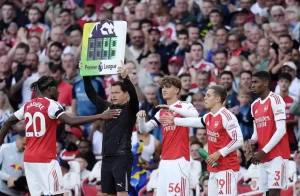
Before the rule change, managers had just three opportunities to alter the course of a match. This limited their ability to rotate tired legs, respond to tactical shifts, or protect key players from injury. Now, with five substitutes, the dynamics of a 90-minute contest have been completely rewritten.
Pep Guardiola and Jürgen Klopp were early advocates of the change, recognizing that their deep squads would benefit enormously. A team like Manchester City can bring on players such as Phil Foden, Julian Álvarez, or Mateo Kovačić—any one of whom would start for most Premier League sides—without significantly dropping quality. For clubs like Luton Town or Sheffield United, the gap between their starting XI and bench options is far more pronounced.
The Data Speaks Volumes
A report from the CIES Football Observatory found that Premier League clubs in the top six positions made an average of 4.7 substitutes per match in the 2023-24 season, compared to just 3.2 for teams in the bottom six. This discrepancy isn’t just a matter of preference—it reflects the reality that bigger clubs have more viable options to bring on.

The impact is most visible in the final 20 minutes of matches. Six6s statistics show that goals scored by substitutes from top-six clubs account for 34% of their total late goals, compared to just 18% for teams outside the top half. This disparity highlights how deeper benches directly translate to more points earned in the closing stages.
The Squad Depth Divide
Financial Implications and Squad Building
The five-substitute rule effectively rewards clubs that have invested heavily in their squads over multiple transfer windows. Manchester United, for instance, can field a completely different attacking lineup in the second half—Marcus Rashford, Antony, and Rasmus Højlund coming off the bench is a luxury that only a handful of clubs can afford.
Smaller clubs face a difficult dilemma. With limited budgets, they must choose between investing in a strong starting XI or spreading resources more thinly to build a deeper bench. The rule change has pushed them toward the latter, but the quality disparity remains stark. A mid-table club’s fifth substitute might be an academy graduate with minimal experience, while a top club’s fifth substitute could be a £50 million signing.
Injury Prevention and Player Welfare
One argument frequently made in favor of five substitutes is player welfare. The Premier League schedule has become increasingly congested, with European competitions, domestic cups, and international breaks creating a relentless calendar. Allowing five changes helps managers protect players from fatigue-related injuries, particularly during the demanding winter period.
However, this benefit also disproportionately favors bigger clubs. Teams competing in the Champions League, Europa League, and domestic cups have more matches and therefore more need for rotation. Their deeper squads allow them to manage workloads effectively, while smaller clubs with fewer resources often cannot afford to rest key players without a significant drop in performance.
Tactical Innovations and Managerial Responses
How Top Managers Are Adapting
The most successful Premier League managers have fully embraced the tactical possibilities of five substitutes. Mikel Arteta at Arsenal frequently uses his bench to shift formations mid-game, moving from a 4-3-3 to a more attacking 4-2-4 when chasing a result. Eddie Howe at Newcastle United has become known for making early bold changes when his team isn’t performing, bringing on attacking players by the 60th minute to change the momentum.
Conversely, managers of smaller clubs often find themselves in a precarious position. Making a substitution too early risks exposing a lack of depth, while waiting too long can mean missing the chance to influence the game. This tactical tightrope walk has become a defining feature of modern Premier League management.
The European Context
It’s worth noting that five substitutes have been standard in most major European leagues since the pandemic. Serie A, La Liga, and the Bundesliga all adopted the rule earlier than the Premier League, and their experience mirrors what English football is now seeing. In Spain, Barcelona and Real Madrid dominate substitute statistics, while in Germany, Bayern Munich’s bench strength has been a decisive factor in their continued domestic dominance.
The Future of the Rule and Potential Adjustments
Calls for a Compromise
Some football analysts and club executives have suggested modifying the rule to level the playing field. Proposals include limiting the number of substitutes to four, or allowing five changes but only in specific circumstances—such as when a team is trailing by a certain margin. Others have suggested that the number of substitutes available on the bench should be standardized across all clubs, removing the current disparity.
For now, though, the five-substitute rule remains firmly in place, and its impact on the competitive balance of the Premier League is unlikely to diminish. As transfer fees continue to rise and the gap between the richest and poorest clubs widens, the ability to rotate five players per match will only become more significant.
What This Means for the Title Race
Looking ahead to the current season, the teams with the deepest benches—Manchester City, Arsenal, Liverpool, and Chelsea—are widely expected to dominate the title race. Their ability to rotate through the congested winter schedule while maintaining quality gives them a clear advantage over challengers like Aston Villa or Tottenham, whose squads are strong but not as deep.
Six6s analysts predict that the five-substitute rule will contribute at least 10-15 extra points to the eventual league champions compared to a three-substitute system. That’s a margin that no smaller club can overcome through tactical brilliance alone.
Conclusion: The New Reality of Premier League Football
The five-substitute rule has permanently changed the Premier League, creating an environment where squad depth is now as important as the starting XI. For bigger clubs with financial muscle and extensive scouting networks, this represents a golden opportunity to maximize their investment. For smaller clubs, it adds another layer of difficulty in an already challenging competitive landscape.
As fans, we’re witnessing a tactical evolution that rewards careful planning, intelligent squad management, and strategic substitution patterns. Whether you love the increased tactical flexibility or lament the growing gap between haves and have-nots, the five-substitute rule is here to stay—and it will continue to shape the Premier League for years to come. Share your thoughts below: do you think the rule should be adjusted, or is it a fair reflection of modern football’s demands? Let’s keep the conversation going.
